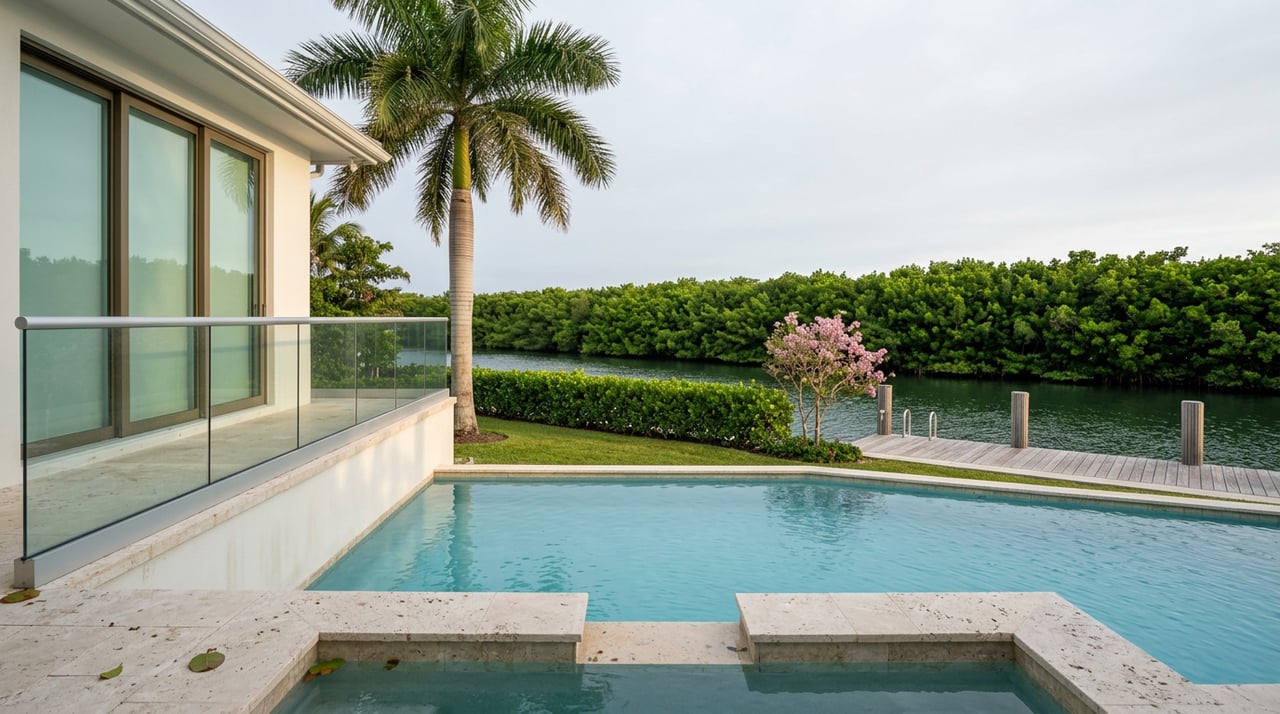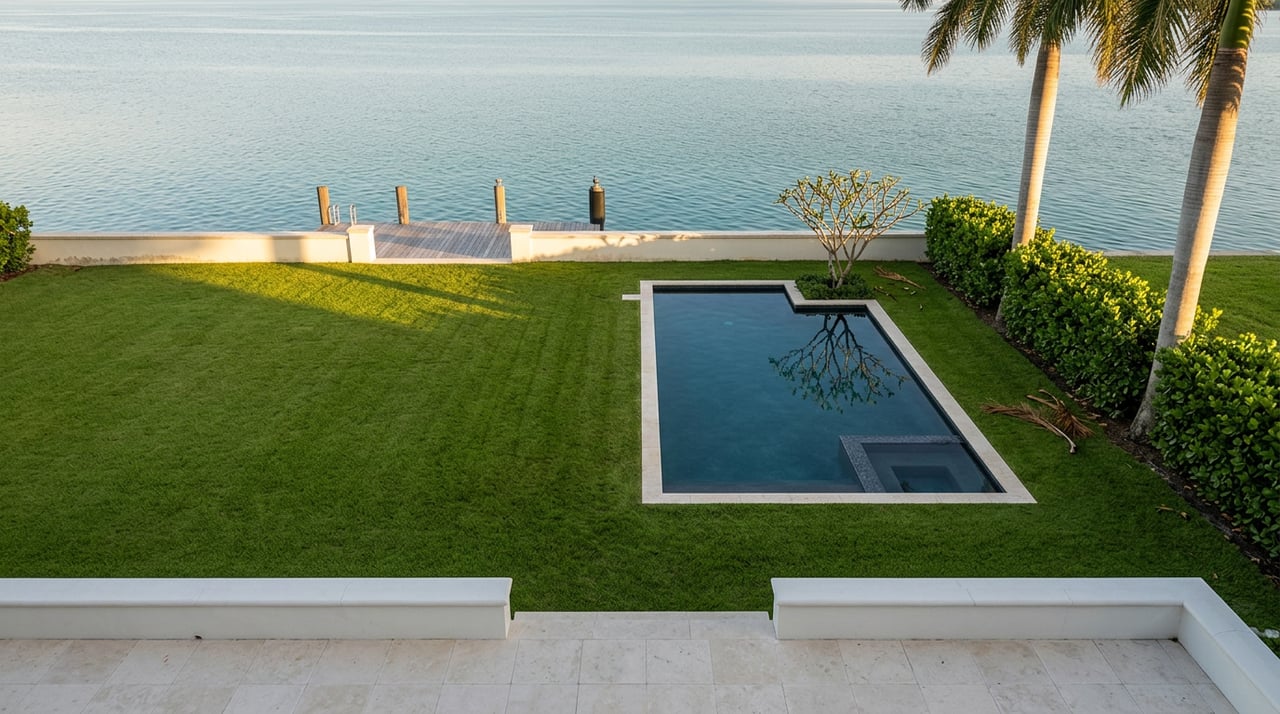
In August 2024, an oceanfront estate at 263 Ocean Boulevard went to contract at its full asking price of $42 million, the priciest property to enter contract in Miami-Dade County that week, according to the Douglas Elliman-authored market report covered by The Real Deal. A month later, the same house closed for $34 million. Eight million dollars disappeared between an accepted offer and a signed deed, on one of the largest homes to trade in the town all year.
That gap is not a fluke. It is Golden Beach's whole market compressed into one transaction. This is a town where the number quoted at the top of a listing and the number that actually clears at the closing table can diverge by nearly a fifth, because so few homes change hands that any single deal can bend the entire curve. If you are comparing Golden Beach to Bal Harbour or Sunny Isles Beach using the median price you saw on a portal, you are comparing it using a number the town's own transaction volume cannot support.
Four Portals, Four Different Towns
Pull up Golden Beach on four different real estate sites right now and you'll get four different pictures of the same 1.3-mile stretch of A1A. One national portal puts the trailing three-month median sale price at $8.8 million as of the period ending May 2026. Another, tracking August 2026 list prices, puts the median at $12.4 million, itself a 16 percent drop from the year before. A local luxury brokerage site reports a March 2026 median sale price above $20 million. A fourth aggregator, pulling from the same regional MLS, lists an average asking price near $19.3 million across its June 2026 inventory snapshot.
None of these sources made an error. They are measuring the same town in the same rough window and arriving at figures that differ by a factor of two or more, because Golden Beach has roughly 364 single-family homes total (the town's own history page puts the figure at 390, a discrepancy that itself says something about how little this market moves) and only a handful trade in any given quarter. A single $34 million closing or a single $3 million teardown can swing a median that would barely register in a market with thousands of annual sales. The number on the portal isn't wrong. It's just not a signal you can act on the way you would in a larger market. Treat it as a headline, not a data point.
The Ceiling Nobody Can Raise
The reason Golden Beach behaves this way traces back to its charter, not its zip code. The town was incorporated in 1929 and its governing documents prohibit commercial development outright. There is no retail strip, no hotel parcel, no path to a condo tower. Every other beachfront community in this stretch of Miami-Dade has some mechanism for adding inventory. A new tower breaks ground in Sunny Isles Beach or Bay Harbor and the market absorbs a fresh wave of units at once, resetting price expectations up and down the corridor. Golden Beach has no equivalent lever. The number of homes has been essentially fixed for decades and will stay that way, because there is no zoning path to add units, only to redevelop the ones that already exist.
The town enforces that framework down to the individual lot. Recent municipal filings show the Council approving consent agreements for potential building and zoning violations at two Ocean Boulevard addresses this year, the kind of routine enforcement that keeps 390 homes conforming to a single low-scale streetscape rather than drifting toward the mixed-use pattern common elsewhere on the coast. For a buyer, that oversight is part of what you're purchasing: a guarantee that the house next door isn't becoming a boutique hotel.
What You're Actually Buying Is the Dirt
Because supply cannot expand, price in Golden Beach detaches from the finished house and attaches to the lot beneath it. Recent land-value analysis based on Miami-Dade county lot sizes and verified sales over the past 24 months puts oceanfront land at a median of roughly $778 per square foot, with individual sales ranging as low as $254 and as high as $1,625 for comparable oceanfront dirt. A 2019-built home on one lot traded near the top of that range. A 1980s structure on similarly sized oceanfront land traded near the bottom, a spread of more than six times on land that a tax map would treat as interchangeable.
Intracoastal land, counterintuitively, traded slightly higher, at a median near $840 per square foot, because oceanfront estates tend to sit on much larger parcels that dilute the per-foot number, while intracoastal lots run smaller and carry concentrated dock value. The practical upshot: price per square foot of finished house, the metric that drives conversation in nearly every other South Florida market, is close to meaningless here. Completed homes have sold anywhere from around $800 to nearly $3,800 per square foot depending entirely on whether the buyer values the existing structure or plans to clear it.
In Golden Beach, the house is the renovation budget. The land is the asset.
That reframing changes how you should read every listing in town, and it explains why 263 Ocean Boulevard could lose $8 million between contract and close. The buyer wasn't renegotiating the house. They were renegotiating what the dirt underneath it was worth once due diligence started.
The Record, and the Listing Still Waiting
Golden Beach's ceiling has moved in recent memory, and the move tells you something about who is buying here. The town's high-water mark remains the 2022 sale of 299 Ocean Boulevard for $45 million, part of a larger assemblage that traded for roughly $93 million total, a deal structured around combining multiple lots rather than valuing any single house. The 263 Ocean Boulevard sale, at $34 million after that contract-to-close haircut, stands as the town's second-largest recorded transaction.
A different kind of data point sits a few addresses down, and it argues for patience rather than urgency. In the summer of 2021, an investor paid a combined $30 million for the adjoining lots at 105 and 115 Ocean Boulevard. In July 2024 he listed both together for $68 million, more than double what he'd paid. As of early 2026, the pair was still on the market, relisted at $67.5 million, essentially the same ask nearly two years later. That single listing has now run longer than Golden Beach's own median time-to-sell, which is less a story about one seller's expectations and more a demonstration of how long "for sale" actually means in this town.
If you are pricing a sale here, or sizing up what a listing actually represents, the lot lines matter more than the square footage on the flyer, and the calendar matters more than either.
A Market That Runs on a Different Clock
The land-value logic connects directly to how long a Golden Beach sale actually takes. Against a broadly balanced market of roughly six months of supply, Golden Beach is currently carrying close to 22 months of inventory overall, and oceanfront alone is running near 27 months, with a median time-to-sell of about 689 days, nearly two years from list to close. That is not a slow season. It is the structural pace of a town where 390 homes rarely change hands and each one waits for a buyer who wants that specific stretch of land badly enough to outlast a long marketing period.
The town itself budgets on a similarly long clock. Golden Beach broke ground on a new Wellness Center in May 2025, a roughly 14,000-square-foot facility with about 6,000 square feet of dedicated gym space, built under a construction agreement with John Bell Construction and targeted for completion at the end of 2026. The same contractor is handling site work and recreational installations for the town's Reimagined Tweddle Park master plan, funded in part through the town's law enforcement trust fund. These are multi-year municipal commitments happening in parallel with individual homes that can sit on the market for two years before finding a buyer. Everything in Golden Beach, public and private, moves on a longer timeline than the rest of the coast.
What This Means If You're Comparing Neighborhoods
If you're cross-shopping Golden Beach against Bal Harbour, Bay Harbor, or Sunny Isles Beach, stop anchoring on the median price you see first. Ask instead how many homes actually sold in the window that number covers, and ask what the underlying lot is worth on a per-square-foot basis rather than what the house is asking. In a market this thin, those two questions tell you more than any portal's headline figure ever will.
A Few Direct Questions
Does a lower reported median mean the market is cooling? Not necessarily. With well under a dozen sales driving any given quarter's figure, a shift in the median often reflects which handful of homes closed, not a change in underlying demand.
Is land value or house condition more important when pricing a listing? Land sets the floor. A well-maintained or newly built structure can push the final price well above that floor, but a dated or deferred-maintenance house on strong land will still trade closer to the land value than the improvement cost would suggest.
How long should I plan for a sale or purchase to take? Recent data points to a median time-to-sell approaching two years, longer on direct oceanfront. Anyone transacting here should build that timeline into their planning from the outset, not treat it as a worst case.
Golden Beach rewards buyers and sellers who understand the mechanics underneath the headline number, not just the number itself. If you're weighing a purchase or a sale in Golden Beach, or trying to make sense of how it stacks up against Bal Harbour, Surfside, or another stretch of this coast, Lydia Eskenazi has spent three decades reading these micro-markets at the address level. Let's connect and schedule a confidential consultation.